
Aluminum die casting alloys are widely recognized for their exceptional properties
Aluminum Die Casting Alloys: Precision and Performance
Aluminum die casting alloys are widely recognized for their exceptional properties, making them a preferred choice in modern manufacturing across various industries.
Key Characteristics
Lightweight & Strong: Aluminum alloys offer an excellent strength-to-weight ratio, crucial for applications where weight reduction is important without compromising structural integrity
Excellent Corrosion Resistance: These alloys naturally form a protective oxide layer when exposed to air, providing enhanced durability in challenging environments
Superior Thermal Conductivity: Ideal for heat dissipation applications such as electronic enclosures and heat sinks
Good Electrical Conductivity: Suitable for components requiring electromagnetic shielding
Recyclability: Aluminum die casting alloys are fully recyclable, supporting sustainable manufacturing practices
| Alloy Designation | Key Features | Typical Applications |
| ADC12 (JIS) | Good castability, wear resistance | Cylinder head covers, sensor brackets, engine blocks |
| A380/A383 (AA) | Excellent fluidity, mechanical properties | Engine blocks, transmission cases, structural parts |
| A360.0 (AA) | High strength, good pressure tightness | Automotive components, aerospace parts |
| AlSi9Cu3 (EN) | Good strength, wear resistance | General engineering components |
Common Aluminum Die Casting Alloys
Here's a quick overview of some commonly used aluminum die casting alloys:
Alloy Designation Key Features Typical Applications
ADC12 (JIS)
Good castability, wear resistance Cylinder head covers, sensor brackets, engine blocks
A380/A383 (AA)
Excellent fluidity, mechanical properties Engine blocks, transmission cases, structural parts
A360.0 (AA)
High strength, good pressure tightness Automotive components, aerospace parts
AlSi9Cu3 (EN)
Good strength, wear resistance General engineering components
Applications
Automotive Industry: Engine blocks, transmission housings, structural components
Aerospace: Lightweight components, brackets, housings
Electronics: Heat sinks, enclosures, communication equipment housings
Consumer Goods: Appliances, furniture components
Design Considerations:
When designing parts for aluminum die casting, consider:
Uniform wall thickness to avoid defects
Appropriate draft angles for mold release
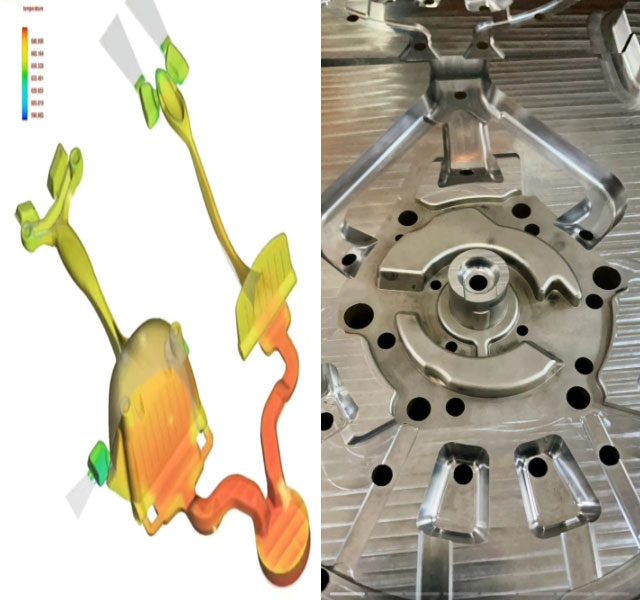
Optimal gate and runner systems for proper metal flow
Aluminum die casting continues to evolve, offering manufacturers innovative solutions for producing high-quality, complex components with excellent dimensional accuracy and surface finish
Note: The specific alloy selection depends on application requirements, mechanical property needs, and cost considerations.

